Understand forex pairs
Learn how currency pairs move, why USD/ZAR can be volatile, how pips work and how spreads affect short-term trades.
Read the guideForex education for South Africa
Liux Network helps new and improving traders understand currency pairs, broker checks, FSCA warnings, position sizing and daily routines before putting money at risk.
Important: Forex and CFDs are leveraged products and losses can exceed expectations. This site is educational only and does not provide personalised financial advice.
Start with the basics that protect capital: what you are trading, who provides the platform, and how much you can lose if the setup fails.
Learn how currency pairs move, why USD/ZAR can be volatile, how pips work and how spreads affect short-term trades.
Read the guideUse a calm checklist for FSCA authorisation, ODP status, company names, FSP numbers, complaints history and withdrawal terms.
View broker checksBuild a repeatable position-size routine so a losing trade stays a planned business cost, not a personal crisis.
Plan your riskEach guide explains one practical decision a South African trader has to make: what market to trade, how leverage changes the numbers, how to move from demo to live, and when a trade should simply be skipped.
A plain-English explanation of currency pairs, bid and ask prices, pips, lots and why the rand can move differently from major pairs.
Open guideHow to read USD/ZAR, what local traders should watch, and why liquidity, news and session timing matter before entering a position.
Open guideUnderstand margin, free margin, margin close-out and why a small deposit can disappear quickly when position size is too large.
Open guideTurn account size, stop distance and risk percentage into a sensible trade size before you press buy or sell.
Open guideBuild a written plan with allowed markets, setup rules, news filters, daily limits and a review routine you can repeat.
Open guideMove from demo practice to a small live account without changing your behaviour the moment real money is involved.
Open guide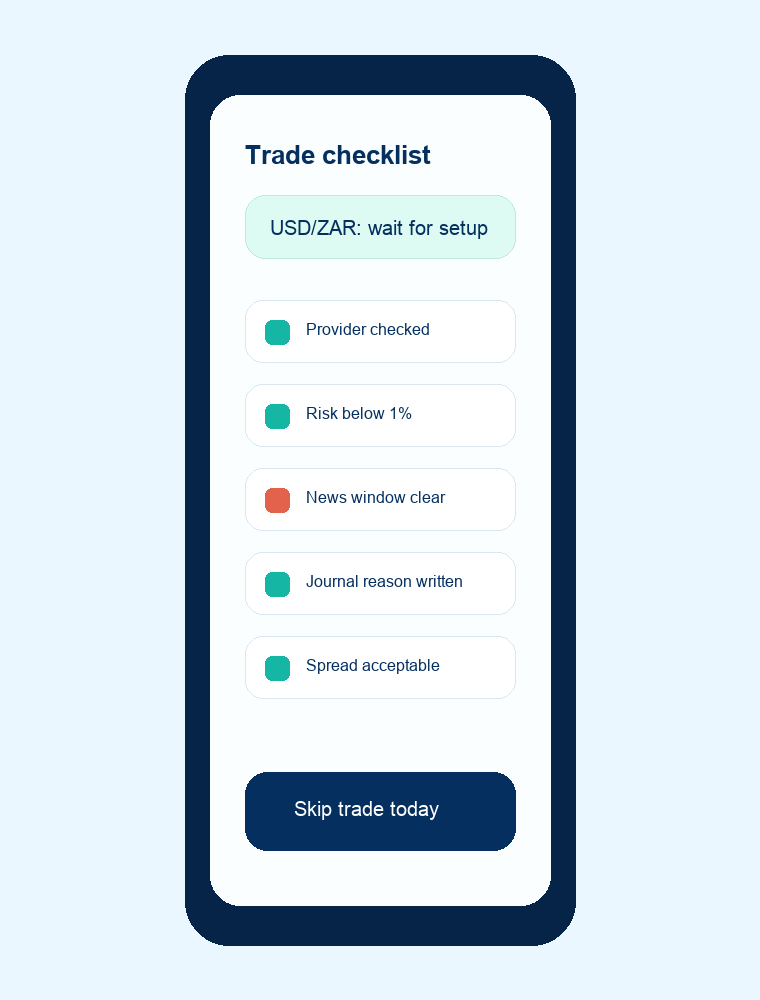
Designed for phone-first readers
Most beginners read, compare brokers and monitor positions from a phone. The guides are written in short sections, with checklist thinking that works on small screens.
South African traders often arrive with local questions that generic forex lessons skip. The rand is familiar, offshore platforms are easy to find, and social media is full of confident claims. That mix makes education and verification especially important.
USD/ZAR does not move only because of South African news. Dollar strength, global risk sentiment, commodity moves and emerging-market flows can all matter. A trader who explains every move with a single local headline can end up forcing the chart to fit a story.
That is why the guides encourage observation first. Watch how the pair behaves around South African data, US inflation numbers, interest-rate decisions and unexpected political headlines. The goal is to become familiar with conditions, not to predict every move.
A polished trading app can make the process feel simple. But the important questions sit behind the interface: which legal entity provides the service, what products are offered, where client money is held, what fees apply, and what happens during a dispute.
Before a deposit, slow down. Compare the broker's claims with public records, read the risk warning, check withdrawal terms and make sure you understand whether you are trading spot forex, CFDs or another derivative product.
Most new traders do better with a sequence than with random videos, chat groups and signals. A clear order keeps the basics from being skipped.
Read the guide on forex pairs, pips, spreads and lots. Then open a demo platform and identify the bid, ask, spread, stop-loss tool and position-size fields without placing trades. The aim is simple platform literacy.
Track USD/ZAR at the same times each day. Note spread changes, sudden moves and the news calendar. Write down what you thought would happen and what actually happened. Do this before risking money.
Take demo trades only when you can define the stop loss and calculate the rand amount at risk. If you cannot explain the loss before entry, the setup is not ready.
Look back at every practice trade and mark whether it followed the plan. A profitable trade that broke rules should not be celebrated as skill. A losing trade that followed the plan may be useful data.
The site is intentionally built around repeatable decisions. Instead of promising a strategy, it helps readers build the judgement needed to evaluate any strategy they encounter later.
Trading involves uncertainty. Any educational site that pretends otherwise is teaching the wrong lesson. The guides focus on risk, process and verification because those are the parts a trader can control.
The broker content explains how to check a provider rather than pushing one account type. Readers are encouraged to verify authorisation, compare documents and test withdrawals before increasing deposits.
Good trading often means waiting. If the spread is poor, the news risk is unclear, or the trade does not fit the plan, the best decision can be no trade at all.
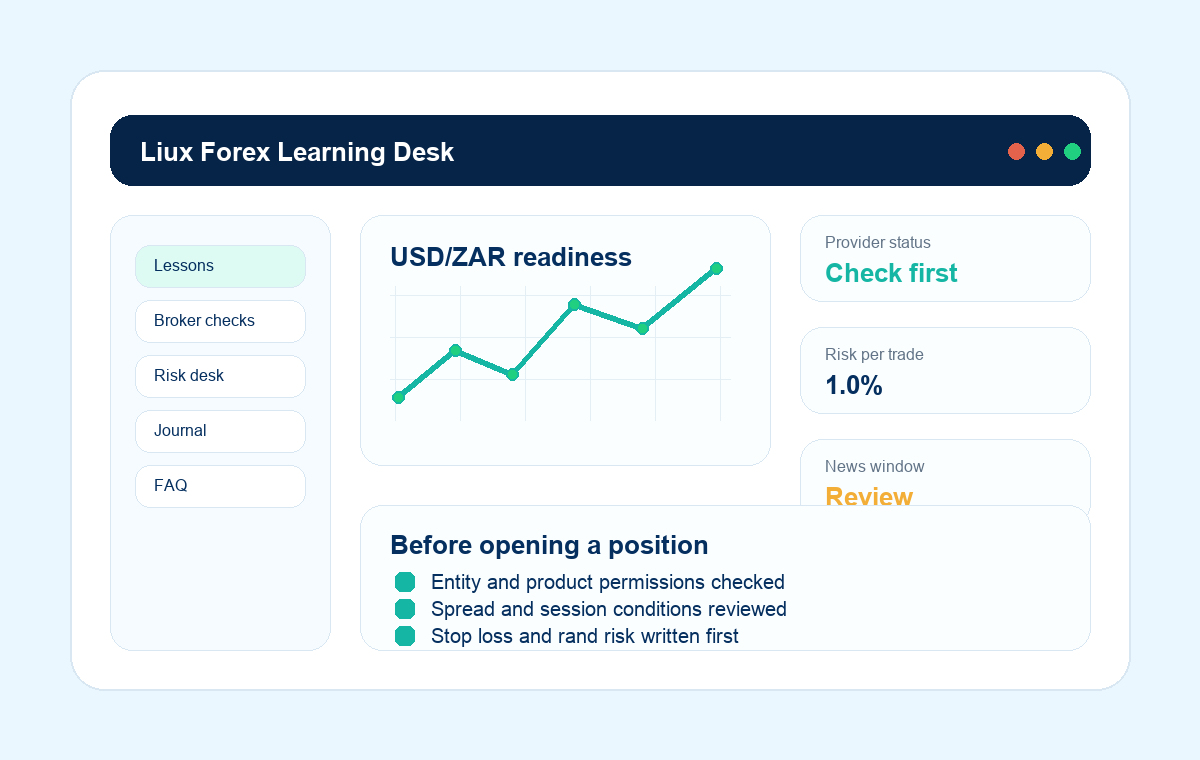
Forex education becomes useful when it turns into a repeatable pre-trade process. The checklist below is deliberately slower than the pace of social media trading content.
Start with the pair. Is it a major pair, a rand pair or a less liquid market? Check the spread, the session, nearby news events and whether the move is already extended. A setup that looks attractive on a chart can become poor if the spread is wide or volatility is abnormal.
Then write the trade idea in one sentence. If the sentence relies on hope, vague momentum or fear of missing out, the trade is not ready. A good idea should include direction, reason, invalidation and risk.
Check your open exposure, recent losses and emotional state. If you are already in several related trades, a new trade may create too much combined risk. If you just hit a loss limit, the next trade may be a reaction rather than an opportunity.
Good traders protect decision quality. They know when to close the platform, when to reduce size and when to wait for a cleaner day. The guides on this site are designed to make those choices feel normal.
The guide library is written to answer the practical questions that usually appear before and after a beginner opens a platform.
Understand base currencies, quote currencies, pips, spreads, bid and ask pricing, lot sizes and why different pairs have different trading costs.
Learn why USD/ZAR can react to local data, US data, global risk appetite and dollar strength at the same time.
Check legal entity names, authorisation, product permissions, ODP status where relevant, fees and withdrawal rules before depositing.
Build rules for per-trade risk, daily loss limits, total exposure, stop placement, slippage and losing streaks.
Write a plan, keep a journal, review weekly and separate market analysis from trade permission.
Move from demo to live gradually, test the broker process and keep early trade size small enough to preserve good behaviour.
Short answers for the points that usually come up before a first live account.
Forex education is legal, but any provider offering financial products or services should be verified. If the product is a CFD or another OTC derivative, check the provider's FSCA authorisation and relevant ODP status.
USD/ZAR is familiar to South Africans but can move sharply. Beginners often benefit from observing it first, recording spread and volatility, and trading only when a written plan is in place.
Signals can hide the most important skill: making and reviewing your own decisions. Treat any signal service, copy trading offer or guaranteed-income claim with caution and verify authorisation before paying.